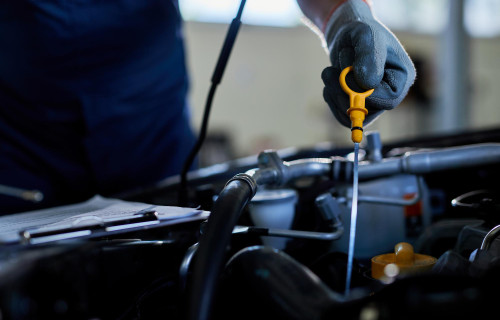
Excessive oil consumption in 2.0 TFSI engines. What should you know? 2.0 TFSI engines are very widespread in many models from Audi, Volkswagen, Seat, and Skoda. They are dynamic, respond well to throttle inputs, and offer plenty of driving pleasure. At the same time, they possess a characteristic that many drivers only learn about after purchasing the vehicle: they can consume engine oil. Important note: A certain amount of oil consumption in an internal combustion engine is normal. The manufacturer anticipates a specific oil consumption for these engines. Therefore, topping up oil does not automatically indicate a defect. It only becomes problematic when oil consumption is too high, increases rapidly, or further symptoms appear. How much oil is a 2.0 TFSI engine allowed to consume? For many 2.0 TFSI engines, the manufacturer allows oil consumption of up to about 0.5 liters per 1000 km. In practice, this means: Mileage Oil consumption at 0.5 l / 1000 km 1000 km up to 0.5 l 2000 km up to 1 l 5000 km up to 2.5 l 10.000 km up to 5 l 15.000 km up to 7.5 l 30.000 km up to 15 l This means: At a mileage of 10.000 km, an engine can consume up to about 5 liters of oil and still be within the limit specified by the manufacturer. With long oil change intervals, for example in LongLife service, the amount of oil topped up can be correspondingly even higher. Nevertheless, this topic should be approached with common sense. The manufacturer's standard does not mean that every instance of oil consumption is unproblematic. Rather, it indicates a technical upper limit within which a certain amount of oil consumption may be possible during engine operation. If an engine consumes 0.5 l per 1000 km, the manufacturer may still consider this within tolerance. For the vehicle owner, however, this already means frequent topping up and regular checking of the oil level. You should be particularly vigilant if: ✔ oil consumption rises rapidly, ✔ the oil level warning appears frequently, ✔ bluish smoke comes out of the exhaust, ✔ the engine runs rough, ✔ compression drops, ✔ there is a lot of oil in the intake system, ✔ the spark plugs are heavily fouled with oil. Why can a 2.0 TFSI engine burn oil? There are several possible causes. Sometimes the problem is relatively easy to fix, while at other times it indicates more severe wear in the engine.
- Piston rings One of the most frequently discussed causes of excessive oil consumption in 2.0 TFSI engines is the piston rings. If the piston rings do not properly scrape oil from the cylinder walls, oil enters the combustion chamber and is burned along with the fuel-air mixture. Possible symptoms include frequent topping up, smoke development, fouled spark plugs, dropping compression, or rough engine running.
- Wear on pistons or cylinders With higher mileage, engine overheating, or neglected maintenance, wear can occur on the cylinder bores. In such a case, the problem cannot always be solved by replacing the crankcase ventilation, the valve stem seals, or the turbocharger. If cylinders or pistons are worn, the engine can continue to consume oil even if ancillary components have already been replaced.
- Valve stem seals Worn valve stem seals can cause oil to enter the combustion chamber via the valve guides. A typical symptom is smoke development after starting, especially after prolonged standing. If the vehicle starts after sitting overnight and bluish smoke appears briefly, this area should also be inspected.
- Turbocharger A damaged turbocharger can force oil into the intake system or into the exhaust tract. The symptoms can resemble engine wear. Therefore, you should not immediately assume the worst-case scenario. During diagnosis, turbocharger bearing play, the amount of oil in the intake system, and the condition of the lines should be checked.
- Crankcase ventilation A defective crankcase ventilation system can lead to incorrect pressure conditions in the engine and increase oil consumption. This is one of the components that should be checked first before considering an expensive engine repair. Defective crankcase ventilation can cause oil to be drawn into the intake system, the engine to run rough, or excessive smoke.
- Excessively long oil change intervals Driving with old oil, especially during long LongLife intervals, can accelerate the formation of carbon and sludge deposits and increase wear in the engine. For 2.0 TFSI engines, regular oil changes are very important. It is better to change the oil more frequently than to let the engine run for a long time with degraded oil, fuel dilution, deposits, and contamination. Typical symptoms of excessive oil consumption The following signs can indicate a problem: ✔ frequent topping up of engine oil, ✔ warning message due to low oil level, ✔ bluish smoke from the exhaust, ✔ smell of burning oil, ✔ oily deposits in the intake system, ✔ spark plugs fouled with oil, ✔ rough engine running, ✔ dropping compression, ✔ degraded performance, ✔ increased fuel consumption, ✔ problems with the catalytic converter or oxygen sensors. You should not only observe how much oil needs to be topped up, but also how quickly the problem develops. If oil consumption increases from month to month, diagnosis should not be postponed. Is it sufficient to just top up oil? In the short term, topping up oil helps maintain the correct oil level. However, it does not eliminate the root cause of the problem. If the engine burns oil due to worn piston rings, pistons, cylinders, turbocharger, or valve stem seals, the problem will generally continue to worsen. An oil level that is too low can lead to severe damage, for example: ✔ wear on the bearing shells, ✔ damage to the camshaft, ✔ damage to the turbocharger, ✔ engine overheating, ✔ engine failure due to seizure. Therefore, regularly checking the oil level should become a habit for engines prone to oil consumption. It is best to check the oil level regularly and not only when a warning message appears. What should you look out for when buying a car with a 2.0 TFSI engine? Before buying, you should check: ✔ when the last oil change was performed, ✔ which oil was used, ✔ whether the previous owner had to top up oil between oil changes, ✔ how much oil the engine consumes per 1000 km, ✔ whether blue smoke comes out of the exhaust, ✔ whether the engine runs smoothly when cold and warm, ✔ whether there are fault codes regarding mixture, ignition, or boost pressure, ✔ the condition of the spark plugs, ✔ compression across the cylinders, ✔ the condition of the turbocharger, ✔ the crankcase ventilation, ✔ oil traces in the intake system. It is sensible to ask the seller directly how much oil the engine consumes per 1000 km. If the answer is vague, the seller avoids the topic, or merely says: "That's normal for every TFSI", you should be cautious. When should oil consumption be a cause for concern? The mere information that a 2.0 TFSI engine consumes oil does not automatically indicate a defect. The manufacturer anticipates a certain amount of oil consumption, and small top-up quantities can be normal in many cases. However, it becomes concerning when: ✔ oil needs to be topped up very frequently, ✔ consumption approaches or exceeds the limit of 0.5 l / 1000 km, ✔ smoke comes out of the exhaust, ✔ the engine loses power, ✔ engine fault codes occur, ✔ the vehicle runs rough, ✔ the oil turns dark quickly and smells burnt, ✔ the problem worsens after every subsequent oil change. In such cases, a precise diagnosis makes more sense than merely continuing to top up. 2.0 TFSI / TSI engine codes frequently associated with increased oil consumption CAEB EA888 Gen.2 very frequently cited in connection with oil consumption CDNC EA888 Gen.2 frequently associated with increased oil consumption CNDC EA888 Gen.2 often mentioned together with CAEB and CDNC CDNB EA888 Gen.2 similar design to CDNC, also to be approached with caution CAEA EA888 Gen.2 found in Audi models, oil consumption can occur depending on the version CAWA EA888 Gen.1 older EA888 variant, can also have oil consumption issues CAWB EA888 Gen.1 older EA888 variant CCTA EA888 Gen.1 more common in the US market, sometimes associated with oil consumption issues CBFA EA888 Gen.1 more common in the US market, similar series to CCTA CCZA EA888 Gen.2 popular 2.0 TSI, possible issues with oil consumption CCZB EA888 Gen.2 similar to CCZA CCZC EA888 Gen.2 possible issues depending on history and version CCZD EA888 Gen.2 possible issues depending on history and version Summary 2.0 TFSI engines can consume oil, and the manufacturer anticipates a certain amount of oil consumption for these engines. In many cases, around 0.5 liters per 1000 km is stated as the limit. This means that at 10.000 km an engine can consume up to about 5 liters of oil, and at 15.000 km even up to about 7.5 liters of oil, and still be within the manufacturer's technical tolerance. Nevertheless, the topic should not be ignored. High or rapidly increasing oil consumption can indicate worn piston rings, cylinders, valve stem seals, a defective turbocharger, defective crankcase ventilation, or the consequences of excessively long oil change intervals. Regular checks of the oil level and timely diagnosis when additional symptoms appear are important. With 2.0 TFSI engines, an oil level that is too low can quickly lead to expensive damage. Therefore, it is better to react early than to wait until increased oil consumption turns into severe engine failure.
Need a reliable replacement engine?
Check matching engines in our stock or decode your VIN to verify compatibility.
Related Articles
Back to all posts
1.4 TSI/TFSI EA111 Engine

Oil Pressure in 3.0 TDI EA897/evo Engines